

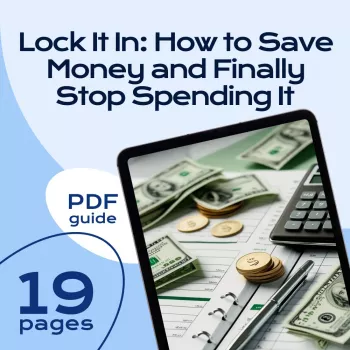
Lock It In Budgeting eBook: Save More, Spend Less

Lock It In: A Practical Budgeting eBook for Saving More and Spending Less
Overspending rarely comes from a lack of effort—it usually comes from frictionless spending, unclear priorities, and a plan that isn’t built for real life. Lock It In: How to Save Money and Finally Stop Spending It is a budgeting eBook designed to turn saving into a repeatable routine, reduce impulse spending, and make day-to-day choices easier with simple rules, prompts, and tracking.
Instead of aiming for perfection, the goal is to build a system that holds up during busy weeks, surprise expenses, and mood-based spending triggers—so progress doesn’t disappear the moment life gets loud.
What “Locking It In” Means (and Why It Works)
- Creates a clear sequence: stabilize essentials, protect savings, then choose spending intentionally.
- Replaces vague goals with small commitments that are easy to repeat (and easier to restart).
- Builds guardrails for common spending triggers like sales pressure, delivery apps, boredom, and stress.
- Uses checkpoints to adjust without abandoning the plan when numbers change mid-month.
A “locked in” budget isn’t rigid—it’s predictable. The structure does the heavy lifting so willpower doesn’t have to show up every time there’s a flash sale or a long day.
What’s Inside the eBook
- A step-by-step budgeting framework that doesn’t require complicated spreadsheets.
- Guidance for setting up accounts and categories so bills, savings, and fun money don’t blur together.
- Strategies to reduce impulse purchases and “just this once” spending.
- Exercises to spot personal spending patterns and replace them with new defaults.
- A practical approach to sinking funds for irregular costs (car repairs, gifts, annual fees).
For extra budgeting fundamentals and worksheets, the Consumer Financial Protection Bureau’s budgeting hub is a solid companion resource: https://www.consumerfinance.gov/consumer-tools/budgeting/.
Quick Start: Set Up a Budget That Doesn’t Collapse Mid-Month
- Choose one budgeting style to start and stick with it for 30 days before changing anything.
- List fixed essentials first: housing, utilities, insurance, minimum debt payments.
- Add true monthly costs by taking annual and irregular expenses and dividing by 12.
- Set one automatic savings transfer timed to payday (even if it’s small at first).
- Assign realistic spending allowances for flexible categories and commit to a stop rule when the money is gone.
The difference between a budget that “looks right” and one that works is the stop rule. A budget without a stopping point turns into a hopeful suggestion.
Common Spending Triggers—and Simple Countermoves
- Convenience spending: Set a weekly cap for delivery/fast food and pre-decide which day it’s allowed.
- Sale pressure: Add a 24-hour waiting rule and keep a “later list” instead of a cart.
- Social spending: Suggest low-cost defaults (walks, coffee, potlucks) and set an event budget before saying yes.
- Stress spending: Create a short list of non-shopping resets (movement, music, journaling, a quick call).
- Subscription creep: Audit monthly charges and cancel anything not used in the last 30 days.
When subscriptions are the leak, it helps to know your rights and how “negative option” billing works. The Federal Trade Commission’s consumer guidance is a reliable starting point: https://consumer.ftc.gov/.
A Simple Monthly Money Map (Example Template)
Start with take-home pay, fund essentials and true monthly costs, pick a savings target small enough to repeat, cap flexible categories, and review for 10 minutes each week to stay aligned.
Example Monthly Budget Allocation (Adjust to Your Income)
| Category | Target Range | Notes |
|---|---|---|
| Essentials (rent, utilities, groceries, transport) | 50–70% | Cover needs first; reduce volatility by planning groceries and fuel |
| Debt payments (minimums + extra if applicable) | 0–20% | Prioritize high-interest debt after essentials are stable |
| Savings (emergency + goals) | 5–20% | Automate a transfer on payday; start small and increase |
| True monthly costs (sinking funds) | 3–10% | Annual fees, gifts, car repairs, medical, school costs |
| Flexible spending (fun, eating out, shopping) | 5–15% | Use a clear cap and a stop rule when the cap is reached |
A 7-Day Reset Plan to Stop Overspending Momentum
Who This Guide Fits Best
How to Use the eBook With Any Pay Schedule
If you want additional free education modules to reinforce the basics, FDIC Money Smart is a trustworthy resource: https://www.fdic.gov/resources/consumers/money-smart/.
What to Expect After 30 Days
Product Details and Value
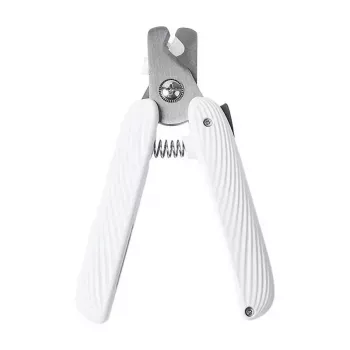
If you’re also tightening up everyday spending decisions, it can help to set a monthly “small essentials” cap for household purchases—then only buy within that boundary. A few examples you can plan for (instead of impulse-buying) include led-illuminated-pet-nail-clipper-with-anti-splash-guard, hand-crocheted-cotton-triangle-scarf-headband-vintage-style-hair-accessory-for-women, or elevated-comfort-cat-small-dog-feeding-bowl. The point isn’t the items—it’s practicing intentional spending with a clear cap.
FAQ
How quickly can results show up?
Small wins can show up in the first week when you cancel one subscription, cap one category, and automate even a modest savings transfer. The first 2–4 weeks are mainly about consistency—getting the routine to stick so the numbers start behaving predictably.
Does this work if income is irregular or bills vary month to month?
Yes, when you use a baseline budget built around your lowest expected month and treat higher-income months as buffer-building. Funding true monthly costs (sinking funds) and adjusting caps prevents the “restart from zero” cycle when bills fluctuate.
What if impulse spending is the main problem?
The most effective approach is combining trigger awareness with friction: waiting rules, category caps, and pre-decided spending days. Removing saved cards, unsubscribing from promos, and keeping a “later list” helps turn impulse buys into deliberate choices.














Leave a comment