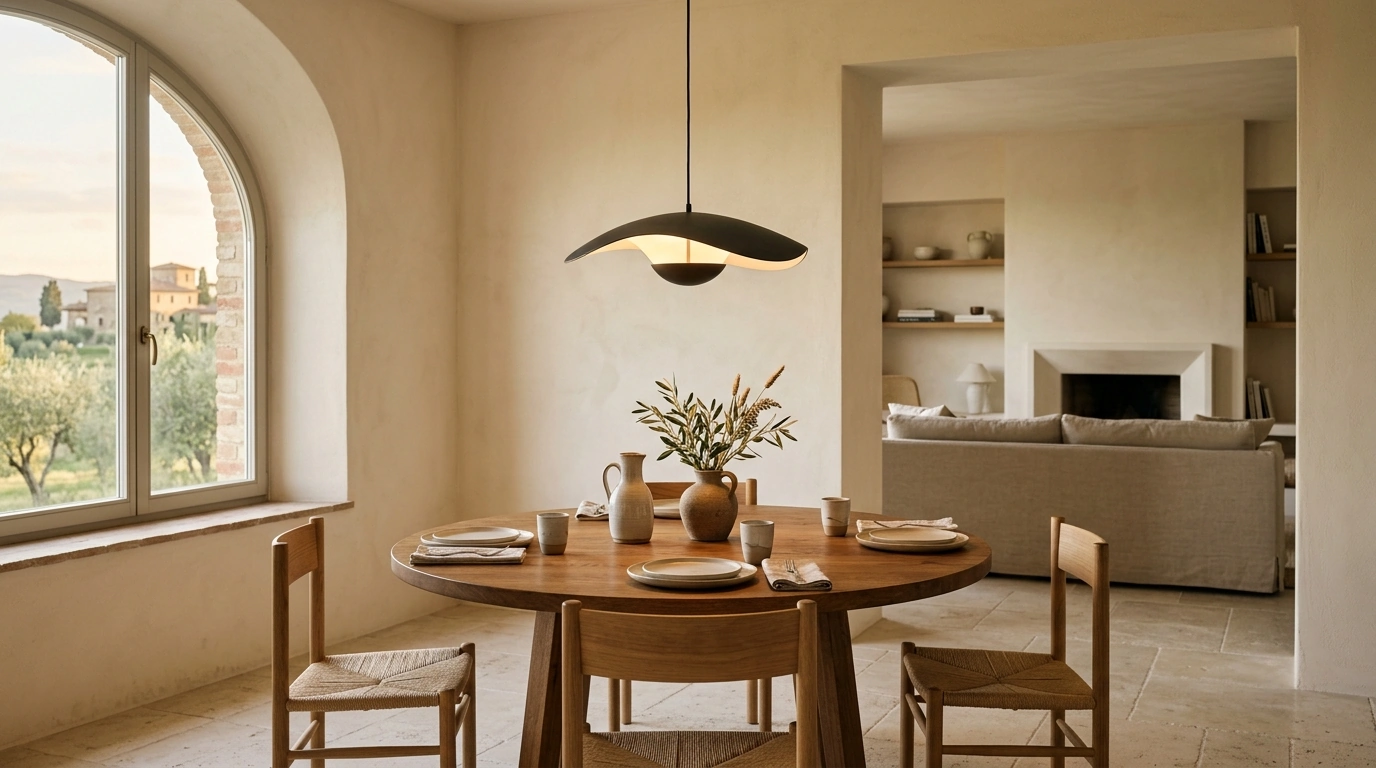
A well-chosen pendant light can anchor a room the way a statement piece of furniture does—defining the dining zone, adding depth over a coffee table, and setting the tone for evening ambiance. This modern minimalist design leans into a refined Italian-inspired look: clean lines, elevated finishes, and a sculptural presence that feels luxurious without visual clutter. For more guidance, see Lights of Scandinavia: Lighting | Shop Ceiling, Wall and Floor Lamps.
Why a minimalist pendant can feel genuinely luxurious
Luxury doesn’t always come from ornament. In many Italian-modern interiors, the most expensive-looking details are the ones that feel effortless—proportions that make sense, materials that read as substantial, and lighting that flatters the room.
- Visual calm: simplified forms highlight proportion, finish quality, and silhouette rather than decoration.
- “Quiet statement” impact: a single sculptural fixture draws attention through balance and negative space.
- Works across styles: pairs naturally with contemporary, Italian modern, Japandi, and soft transitional interiors.
- Layering-friendly: minimalist pendants leave room for wall sconces, floor lamps, and art without competing.
Best placement for living rooms and dining areas
Placement is what turns a pendant from “nice” to “intentional.” The goal is to align the fixture with the surface or seating area it serves—especially in open-plan spaces where ceiling boxes aren’t always centered over furniture.
- Dining table placement: center the pendant over the table’s midpoint (not the room’s ceiling box if it’s off-center).
- Over a round table: a single pendant often reads cleaner; choose a diameter that looks proportional to the tabletop.
- Over a rectangular table: one larger pendant can work, but multiple pendants in a line create a more architectural rhythm.
- Living room zone: hang above a coffee table or seating cluster to define the area—especially in open-plan layouts.
- Avoid glare lines: position so the light source isn’t in a direct seated sightline from sofas or dining chairs.
Sizing and hanging height guidelines
Great lighting is felt more than noticed—no squinting, no harsh hotspots, and no “too-low” fixture interrupting conversation. Start with clearance, then refine for proportion and comfort.
- General rule: the pendant should feel centered to the surface below and leave adequate head clearance.
- Dining height: measure from tabletop to the bottom of the pendant; adjust higher for taller ceilings or larger fixtures.
- Living room height: keep it high enough that standing adults comfortably pass under it, with clear walking paths.
- Canopy location: if the ceiling junction box is off-center, a swag hook or adjustable canopy solution (if compatible) can visually “correct” alignment.
- Open concept tip: align the pendant with architectural lines (island edge, table edge, or rug center) so it doesn’t look like it’s floating to one side.
Quick hanging-height guide (typical residential use)
| Location |
Ceiling height |
Recommended clearance |
Notes |
| Dining table |
8 ft (2.4 m) |
28–34 in (71–86 cm) above tabletop |
Raise slightly for larger fixtures or very bright bulbs |
| Dining table |
9 ft (2.7 m) |
30–36 in (76–91 cm) above tabletop |
Keep bottom of fixture comfortably above eye level when seated |
| Living room (over coffee table) |
8–9 ft (2.4–2.7 m) |
At least 7 ft (2.1 m) from floor to bottom |
Higher is better for circulation in busy walkways |
| Open walkway area |
Any |
At least 7 ft (2.1 m) from floor to bottom |
Use a flush or semi-flush option if ceiling is low |
Light quality: brightness, color temperature, and dimming
A minimalist pendant looks best when the light itself is equally refined—soft where it should be soft, bright where you need clarity, and adjustable for different moments.
- Brightness planning: dining areas typically benefit from stronger task light, while living rooms often prioritize softer ambient layers.
- Color temperature: warm white (about 2700K–3000K) complements wood tones and cozy evenings; neutral white (around 3500K) reads crisper in modern spaces.
- Glare control: shades or diffusion help reduce harsh hotspots—especially on glossy tables or stone tops.
- Dimming: a compatible dimmer switch helps shift from entertaining to everyday comfort; confirm compatibility with your bulb or LED driver type.
- Layering strategy: pair the pendant with wall lights or a floor lamp so the room stays comfortable even when the pendant is turned down.
For practical efficiency and longevity benefits of LEDs, reference the U.S. Department of Energy LED lighting guidance. If you’re planning a more technical lighting scheme, the Illuminating Engineering Society (IES) is a helpful authority on lighting practices.
Materials and finish considerations for an Italian-inspired look
Minimalism puts the spotlight on surfaces. When finishes are thoughtfully chosen, even a simple silhouette reads premium.
Installation notes and safety checkpoints
A styled approach: making the pendant feel intentional
Shop in-stock favorites
FAQ
How high should a pendant light hang above a dining table?
A typical guideline is 28–36 inches from the tabletop to the bottom of the pendant, adjusted for ceiling height and fixture size. If the light creates glare while seated, raise it slightly or use a softer bulb/diffuser.
Is a pendant light suitable as the main light in a living room?
It can work as a central ambient layer and a strong focal point, especially in open layouts. Comfort improves when it’s paired with layered lighting (floor lamps or sconces) and a dimmer to avoid harsh brightness.
What color temperature works best for a modern minimalist dining area?
Most minimalist dining spaces look best with warm-to-neutral light: 2700K–3000K for cozy evenings, or 3000K–3500K for a crisper modern feel. Match nearby bulbs in the same sightline so the room doesn’t look mixed or uneven.
Recommended for you











Leave a comment